TL;DR:
- Most renovation conflicts and budget overruns stem from an unclear or incomplete project scope, not contractor issues. A detailed, written scope defines work, expectations, exclusions, and change processes, preventing miscommunication and costly surprises. Breaking projects into phases and maintaining a living scope document help homeowners manage costs, permits, and project adaptability effectively.
Most renovation conflicts and budget overruns don’t start with bad contractors or bad luck. They start with an unclear or incomplete project scope. That single document, or lack of one, is behind more disputes, surprise costs, and stalled projects than any other factor in residential remodeling. If you’re a homeowner in Lower or Central Bucks County or New Castle, Delaware, understanding what project scope really means, and how to define it properly, can save you thousands of dollars and a tremendous amount of stress before a single wall comes down.
Table of Contents
- What is renovation project scope?
- Core elements every renovation scope should include
- How scope impacts budget, schedule, and regulatory requirements
- Phased approaches: Defining scope by room or system for practical results
- Your renovation scope checklist: Setting expectations and preventing surprises
- Why most scope problems are preventable — and what experienced renovators do differently
- Ready to define your renovation scope with confidence?
- Frequently asked questions
Key Takeaways
| Point | Details |
|---|---|
| Scope defines success | A detailed scope is your key to accurate estimating, on-time completion, and minimal surprises. |
| Include key elements | Always specify deliverables, exclusions, acceptance criteria, and a change-order process in your scope. |
| Permits are scope-driven | Your scope determines what permits and inspections are needed in Bucks County and Delaware. |
| Phasing reduces risk | Breaking your renovation into room or system phases helps manage budget and complexity. |
| Checklist = clarity | Using a scope checklist or packet sets clear expectations for contractors and protects you from costly disputes. |
What is renovation project scope?
With that context in mind, let’s clarify what “project scope” really means in your renovation.
Simply put, project scope is the detailed, written definition of what work will be done, including every task, material choice, and expectation, and it serves as the shared rulebook for everyone involved. Think of it as the contract’s backbone. Without it, your contractor might assume the price includes drywall repair after tile work, while you assume it doesn’t. These small gaps add up fast.
“Project scope is the single most powerful tool a homeowner has to prevent surprises. When everyone reads from the same document, miscommunication drops dramatically.” — Industry best practice in residential remodeling
A strong scope document does several important things at once:
- It gives your contractor a clear basis for accurate estimating
- It forms the foundation of your contract and payment schedule
- It protects you if disputes arise about what was or wasn’t included
- It keeps the project on schedule by reducing back-and-forth decisions mid-build
- It flags what is not included, which is just as important as what is
Familiarity with renovation terms makes this process much smoother. If you’re newer to remodeling, brushing up on the language helps you communicate clearly and read your scope documents with confidence. You can also find broader context in this property renovation guide if you want a fuller picture before going deeper.
For homeowners in Bucks County, this is especially relevant. Older homes, which are common throughout Doylestown, Langhorne, and Bristol, often hide surprises inside walls and under floors. A well-written scope acknowledges those potential unknowns and sets a process for handling them without derailing the budget.
Core elements every renovation scope should include
Now that you understand what project scope is, let’s break down what actually goes into a robust renovation scope.
A properly scoped renovation includes far more than a task list. According to scope best practices, every solid scope document covers boundaries, constraints, acceptance criteria, and a defined process for handling changes. Think of these as the six pillars of a strong scope:
- Objectives — What is the end goal? (e.g., fully functional kitchen with updated plumbing and cabinetry)
- Deliverables — Specific outputs expected at project completion (e.g., new tile floor installed, grout sealed, fixtures connected)
- Exclusions — What is explicitly not covered (e.g., painting adjacent hallway, replacing appliances)
- Constraints — Budget ceiling, timeline, access limitations, or HOA rules
- Acceptance criteria — How you and your contractor agree that work is done correctly (e.g., all tile edges flush, no grout gaps wider than 1/16 inch)
- Change order process — The agreed-upon steps for documenting and pricing any work added or removed after the scope is signed
Pro Tip: Never skip the exclusions section. That’s where most misunderstandings live. If it’s not written down as excluded, your contractor may assume it’s included, and vice versa.
Organizing the scope so both homeowner and contractor can price and schedule accurately means breaking work into trades or phases, and including technical specs, milestones, and payment mechanics. For example, rather than writing “renovate bathroom,” a well-organized scope would list: tile demo, subfloor inspection, waterproofing membrane installation, new tile layout and grouting, vanity installation, plumbing fixture connections, and final inspection.
Here’s a quick comparison of what typically falls inside and outside a standard renovation scope:
| Scope item | Usually included | Commonly excluded |
|---|---|---|
| Demolition of specified area | Yes | Adjacent rooms unless noted |
| Material supply (if listed) | Yes | Specialty items not pre-selected |
| Permit application | Sometimes | Often a separate line item |
| Cleanup and debris removal | Usually yes | Hazardous material disposal |
| Repair of hidden damage | Rarely | Typically a change order |
| Touch-up painting in work area | Often yes | Full room or home painting |
| Appliance installation | If specified | Appliance purchase itself |
Understanding roles in home renovation also helps here. When you know who is responsible for what, your scope can assign tasks correctly and avoid gaps between trades. Getting renovation estimates from multiple contractors also becomes far more useful when each bid is based on the same written scope, making apples-to-apples comparisons possible. Knowing your remodeling timeline helps you set realistic milestones within that scope as well.

How scope impacts budget, schedule, and regulatory requirements
But what does all that mean for your budget and the legal steps you’ll need to take? Let’s connect the dots.
The size and detail of your scope directly determines how much your project costs, how long it takes, and which permits your local jurisdiction requires. This is not a gray area. It’s a direct cause-and-effect relationship.
In Bucks County, older homes and structural or MEP work (MEP stands for mechanical, electrical, and plumbing systems) almost always expand both scope and final budget once work begins. Opening a wall in a 1950s colonial in Newtown might reveal ungrounded wiring, asbestos-wrapped pipes, or undersized joists. None of that was in the original scope. Without a change-order process, you’re in a very uncomfortable position.
In Delaware, scope determines permitting needs based on which systems are affected and which local jurisdiction governs your property. New Castle County has its own plan review requirements, and work involving structural changes, new plumbing runs, or HVAC modifications almost always triggers inspections.
Here’s how common scope decisions translate into permit and regulatory requirements:
| Type of work | Permit likely required? | Inspection triggered? |
|---|---|---|
| Moving or removing a load-bearing wall | Yes | Yes, structural |
| New electrical circuit or panel upgrade | Yes | Yes, electrical |
| Relocating plumbing lines | Yes | Yes, plumbing rough-in |
| HVAC replacement or new ductwork | Yes | Yes, mechanical |
| Roof replacement (full) | Yes | Yes, framing/final |
| Flooring replacement only | Usually no | No |
| Interior painting only | No | No |
| Cabinet replacement (no plumbing move) | Usually no | No |
Hidden conditions and regulatory triggers are the most common reasons a renovation scope expands unexpectedly. Scoping a project without addressing these possibilities, especially in older homes, is a recipe for sticker shock.
Pro Tip: Before signing a contract, ask your contractor directly: “What conditions, if discovered during demo, would require a change order?” Their answer tells you how experienced they are with local building stock and code requirements. For those remodeling older homes, this conversation is non-negotiable.
Phased approaches: Defining scope by room or system for practical results
With the impact of scope on cost and permitting in mind, let’s see how breaking your renovation into practical phases can offer clarity and control.
Here’s something most renovation articles won’t tell you: very few homeowners remodel their entire home in one project. Most homeowners renovate by phase or area rather than tackling everything at once, and that’s not a sign of limited ambition. It’s a smart strategy. Phased scoping is how experienced renovators control costs, maintain livable spaces during construction, and reduce permit complexity.
Popular phased-scope strategies include:
- Kitchen only — Define the full kitchen scope including all cabinetry, countertops, plumbing, electrical, and flooring as a self-contained project
- Primary bathroom renovation — Tile, vanity, plumbing fixtures, and ventilation as one defined phase
- Electrical system upgrade — Panel replacement, rewiring, and GFCI updates throughout the home, separate from cosmetic work
- Basement finishing — Framing, insulation, drywall, lighting, and egress as a standalone scope package
- Flooring throughout — Hardwood refinishing or new flooring installation across multiple rooms with a single scope and timeline
- Roof replacement — A complete exterior scope that stands alone from any interior work
Each of these represents a scope “package” with its own objectives, deliverables, exclusions, and acceptance criteria. That structure makes budgeting simpler, coordination with contractors easier, and living through the renovation far more manageable.
Pro Tip: Treat each phase as its own mini-scope. Write a one-page summary, list your material selections with model numbers, and define exactly what done looks like before work starts. It takes an hour upfront and saves days of confusion later.
Good project management for remodels starts with this kind of phase-based thinking. Whether you’re starting with a bathroom renovation or planning a larger sequence of projects, careful renovation planning makes each phase go more smoothly than the last.
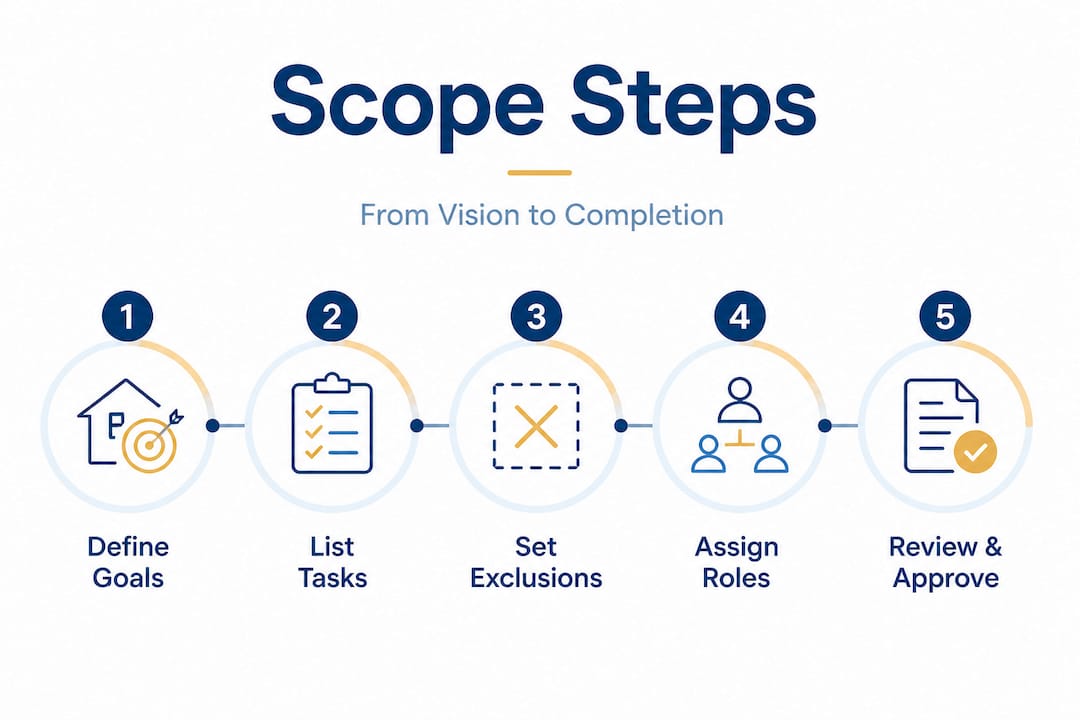
Your renovation scope checklist: Setting expectations and preventing surprises
To wrap up, here’s a hands-on checklist you can use to make sure your project scope is rock-solid before demolition begins.
A complete scope packet isn’t just one document. It’s a small collection of materials that together give everyone on the project a shared, unambiguous reference point. A typical scope packet includes a one-page summary, selections with model numbers, marked plans, stated assumptions and exclusions, and site constraints.
Here’s a numbered checklist to build your own:
- One-page project summary — A brief overview of what the project is, where it’s located in your home, and the overall goal. This is the document everyone references first.
- Detailed task list by trade — List demolition, framing, plumbing, electrical, tile, cabinetry, and finish work separately. Avoid combining trades into vague line items.
- Material selections with model numbers — Every tile, fixture, cabinet line, paint color, and hardware item should be named and numbered. Vague descriptions lead to substitutions.
- Marked floor plans or photos — Even a hand-drawn sketch showing the work area boundaries prevents disputes about where the scope begins and ends.
- Written exclusions — List everything that is not included, even if it seems obvious. This protects both you and your contractor.
- Assumptions and site constraints — Note any access limitations, parking restrictions, HOA rules, or existing conditions that affect the project.
- Change order process in writing — Agree in advance on how changes will be requested, priced, and approved before any additional work begins.
- Payment schedule tied to milestones — Payments should align with completed phases, not arbitrary dates, to keep everyone accountable.
- Acceptance criteria per phase — Write down what “done” looks like at each milestone so inspections and final walkthroughs have a clear standard.
- Permit and inspection log — Track which permits are required, who pulls them, and when inspections are scheduled.
Pro Tip: Save both a digital and a printed copy of your scope packet. Bring the printed copy to every site meeting and compare it against any invoices or change orders you receive. Small discrepancies are far easier to resolve in real time than after the project closes.
Why most scope problems are preventable — and what experienced renovators do differently
Here’s an honest observation from years of working with homeowners across Bucks County and New Castle: the checklist matters, but it’s not the whole answer. Most scope problems aren’t caused by missing a checklist item. They’re caused by treating the scope as a one-time document rather than a living baseline for the entire project.
The homeowners who have the smoothest renovations aren’t the ones with the longest initial scope documents. They’re the ones who treat the scope as something to revisit, especially after the first demolition phase. That’s when the walls open up, the real condition of the structure becomes visible, and decisions that seemed simple on paper suddenly require a conversation. Experienced renovators expect this and handle it calmly because they’ve already agreed on a change order process.
Exclusions, in our experience, cause more friction than any other scope element. It’s not that contractors are hiding things. It’s that both parties genuinely assumed something different about who was responsible for a specific task. The fix is almost always a conversation, but that conversation needs a written record. Speaking the same language as your contractor helps ensure nothing gets lost in translation when those moments arise.
Document every change, no matter how minor. A verbal agreement to swap out one light fixture for another seems trivial, but it can affect the electrical budget, the inspection schedule, and the final invoice. Small undocumented changes are where trust erodes. Keep everyone on the same page, in writing, and your renovation will feel far less like a gamble and much more like a managed project.
Ready to define your renovation scope with confidence?
If you’re ready to move from learning to planning, clear next steps can make the difference between a dream renovation and a renovation nightmare.
At Precision Remodeling Solutions, we work with homeowners throughout Lower and Central Bucks County and New Castle, Delaware, to build clear, detailed project scopes from the very first consultation. Whether you’re thinking about a kitchen remodeling project or planning a full bathroom remodeling overhaul, we help you define exactly what’s included, what isn’t, and what to expect at every stage. Start with our property renovation complete guide to sharpen your planning foundation, then reach out for a free estimate. Getting scope right from the start is the single best investment you can make in your renovation.
Frequently asked questions
Why is having a detailed renovation scope so important?
A detailed, written scope defines every task, expectation, and boundary of the project, which prevents misunderstandings, budgeting errors, and costly disputes between homeowners and contractors.
What’s typically not included in a renovation project scope?
Common exclusions include work outside the specified area, repair of hidden conditions discovered during demo, and items not listed as deliverables. As scope best practices confirm, documenting exclusions clearly is what prevents scope creep and surprise costs.
How can renovation scope affect permit requirements in Delaware and Bucks County?
The type and extent of work in your scope directly determines whether permits or inspections are required. When work involves major systems, New Castle County plan review and inspections may apply, and the same is true across Bucks County jurisdictions.
What is a change order and why does it matter for homeowners?
A change order is a written agreement documenting work added or removed from the original scope. Defining a change order process before work starts is what controls scope creep and ensures changes are priced and approved before anyone picks up a tool.
Should I plan my renovation all at once or in phases?
A phased approach is almost always more practical. Most homeowners renovate by area or phase rather than tackling the whole home at once, which simplifies budgeting, permits, and day-to-day living during construction.
Recommended
- Home renovation terms: speak your project’s language – Precision Remodeling Solutions
- What is property renovation? A homeowner’s complete guide – Precision Remodeling Solutions
- Project management for remodels: a homeowner’s step-by-step guide – Precision Remodeling Solutions
- Home renovation estimates: What homeowners need to know – Precision Remodeling Solutions