TL;DR:
- Renovation estimates predict costs based on current information and include components like materials, labor, and contingency.
- Estimate accuracy varies by project stage, with early estimates having high uncertainty, especially in older homes.
- Always request itemized estimates, understand their class, and budget for hidden costs and surprises.
You open three renovation estimates on your kitchen table, and every number is different. One contractor quotes $42,000, another says $67,000, and the third comes in at $55,500. You don’t know which one is accurate, what’s included, or why they vary so wildly. This confusion is one of the most common and stressful moments in any home renovation project. A renovation estimate isn’t just a price tag. It’s a layered document with assumptions, uncertainties, and specific components that all affect the final number. This guide will help you understand how estimates are built, why they differ, and how to use them to plan your project with real confidence.
Table of Contents
- What is a home renovation estimate?
- Understanding estimate classes and accuracy ranges
- How renovation cost estimates are built: Components and hidden factors
- Budgeting for expansions and additions: Real-world cost examples
- Our take: What most homeowners get wrong about renovation estimates
- Get an estimate you can trust from local experts
- Frequently asked questions
Key Takeaways
| Point | Details |
|---|---|
| Estimate is a forecast | A home renovation estimate predicts project costs, not guarantees them. |
| Estimate accuracy varies | Expect broader cost ranges early and tighter numbers once details are finalized. |
| Check what’s included | Always verify which costs, scope, and contingencies are included before making decisions. |
| Hidden costs matter | Budget for permits, waste, and surprise repairs to avoid financial shocks. |
| Multiple quotes help | Request several detailed estimates to clarify value and reduce risk. |
What is a home renovation estimate?
Now that we’ve set the stage, let’s clarify what a renovation estimate really means.
A home renovation estimate is a monetary forecast for completing a defined scope of work on an existing home, typically produced before construction starts and distinct from the final contractor bid. That distinction matters. An estimate is a prediction based on available information at a specific point in time. A bid, on the other hand, is a formal, often binding price a contractor commits to once the scope is fully defined.
Renovation estimates carry more uncertainty than new construction estimates. Why? Because existing homes hold surprises. Behind those walls could be outdated wiring, old plumbing, or structural issues that weren’t visible during a walk-through. New builds start from scratch with full design plans. Renovations don’t have that luxury.
“An estimate is not a guarantee. It is your best financial picture based on what’s known today. The more you know about your home’s condition, the tighter that picture becomes.”
Every renovation estimate is built from a few core components. Understanding these will help you read any estimate more clearly:
- Direct materials: The cost of physical items like cabinets, tile, lumber, and fixtures
- Direct labor: The wages paid to skilled tradespeople doing the work
- Overhead and profit: The contractor’s business costs and margin
- Contingency: A reserve fund for unknowns, typically ranging from 5% to 15% of the total
You can learn more about the different cost estimate methods used in residential projects and even brush up on remodeling terminology so you can follow the conversation with any contractor confidently.
Understanding estimate classes and accuracy ranges
With a base understanding, here’s why not all estimates are created equal.
Cost estimates are commonly expressed as estimate “classes” with different accuracy ranges depending on project stage, from conceptual to definitive. Most homeowners never hear about this system, but it explains a lot about why numbers vary so much in early conversations.
Here’s a simplified breakdown of how estimate classes work:
| Estimate class | Project stage | Typical accuracy range |
|---|---|---|
| Class 5 (order of magnitude) | Early concept, rough idea | -50% to +100% |
| Class 4 (study estimate) | Preliminary scope defined | -30% to +50% |
| Class 3 (budget estimate) | Schematic design started | -20% to +30% |
| Class 2 (control estimate) | Nearly complete design | -10% to +20% |
| Class 1 (definitive estimate) | Full plans and specs | -5% to +15% |
When a contractor visits your home for the first time and gives you a quick number after a 30-minute walk-through, you are likely receiving a Class 4 or Class 5 estimate. That’s useful for ballparking a budget. It is not a reliable number to lock into a contract.
As your project moves forward and more details are confirmed, the estimate becomes more accurate. This is a normal and healthy part of the process. Problems arise when homeowners treat an early estimate as a firm price.

Pro Tip: Before accepting any estimate, ask the contractor directly: “What class of estimate is this, and what level of detail is it based on?” Most won’t use that exact language, but asking about their assumptions and what’s not included tells you a lot. You can also compare estimates more fairly by reviewing guidance on comparing renovation estimates and by working with choosing reliable contractors who explain their process clearly.
How renovation cost estimates are built: Components and hidden factors
Estimates aren’t just a sum of visible tasks. Let’s see how the numbers are actually built.
A practical way to estimate renovation costs is to break work into categories such as direct materials, direct labor, and overhead and profit, then add contingencies for uncertainty. That’s the framework. But the details inside each category can vary significantly based on your home, your location, and the time of year.
Hidden and indirect costs are where many homeowners get caught off guard. Homeowners should account for permitting fees, waste removal, and uncovered condition issues rather than relying only on fixture and finish prices. These costs are real, and they add up fast.
Here’s a look at common hidden costs that frequently appear in renovation projects:
| Hidden cost category | What it covers | Estimated cost range |
|---|---|---|
| Permit fees | Required approvals from local municipalities | $200 to $2,500+ |
| Waste removal | Dumpster rental and debris hauling | $300 to $1,500 |
| System upgrades | Electrical panel, plumbing rerouting | $1,000 to $10,000+ |
| Structural repairs | Subfloor, joists, load-bearing corrections | $500 to $20,000+ |
Older homes are especially unpredictable. A 1950s kitchen renovation might reveal knob-and-tube wiring that must be replaced before any other work continues. That wasn’t in the original estimate because it wasn’t visible. This is also why contingency budgets matter so much.
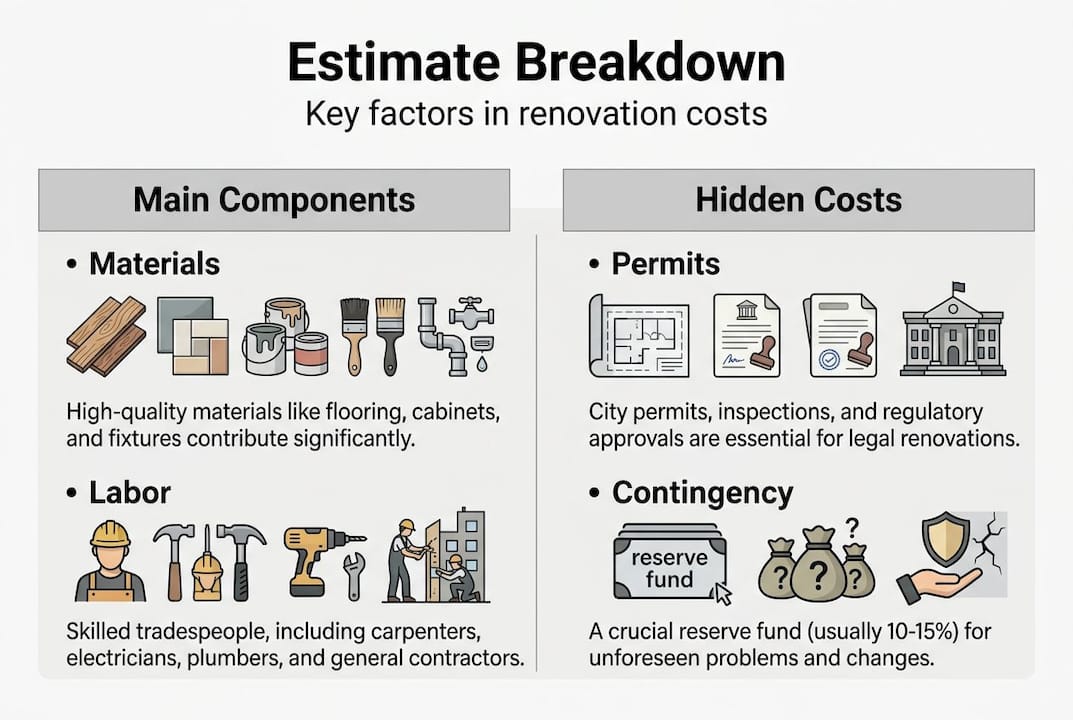
A contingency of 5% might be enough for a newer home with fewer unknowns. For homes built before 1980, consider budgeting 10% to 15% as a safety net. This isn’t pessimism. It’s preparation.
Pro Tip: Don’t skip the permit step to save money. Unpermitted work can delay or kill a home sale and may even require expensive removal and redo later. Learn more about what impacts your unexpected remodeling costs so you can plan with eyes wide open.
The most trustworthy estimates break out each category line by line. If you receive a one-number estimate with no breakdown, ask for itemization before moving forward.
Budgeting for expansions and additions: Real-world cost examples
Now, let’s translate framework into reality with numbers and actionable steps for your next project.
For home additions, per-square-foot budgeting is often used, but the total cost can vary widely. Multiple estimates and a professional builder’s estimate are strongly recommended before committing to any budget. Here are some general ranges to anchor your planning:
- Kitchen remodels: Minor updates can run $15,000 to $30,000. Mid-range renovations typically fall between $40,000 and $70,000. High-end overhauls can exceed $100,000.
- Bathroom remodels: Basic refreshes start around $8,000 to $15,000. Full remodels with tile, fixtures, and layout changes often range from $20,000 to $50,000.
- Home additions: Expect $150 to $300 per square foot for a standard addition, depending on complexity and finishes.
These numbers give you a starting point, not a final answer. Your specific project, your home’s existing conditions, and local labor rates in Bucks County or New Castle, Delaware, will all influence your actual costs.
Here are four steps to getting an estimate you can actually rely on:
- Get at least three quotes. No single estimate tells you enough. Three quotes give you a range and help you spot outliers.
- Define your scope before reaching out. A vague request gets a vague estimate. Know what you want to change, add, or update.
- Ask what’s included and excluded. Hidden exclusions are often where budget surprises hide.
- Be cautious with very low bids. A lowball estimate often means something was left out, or quality will suffer. Understand the cost vs. value of additions before choosing purely on price.
Online calculators can give you a rough sense of what a project might cost, but they can’t account for your home’s unique conditions, local permit requirements, or the true scope of your vision. Use them as a starting point only.
Our take: What most homeowners get wrong about renovation estimates
After understanding the facts, here’s a perspective that could change the way you approach estimates.
Most homeowners receive an estimate and immediately focus on the single number at the bottom. That’s understandable. But that single number creates a false sense of certainty. It implies precision that simply doesn’t exist early in the planning process.
We’ve seen it happen repeatedly with older homes in Bucks County and New Castle. A homeowner gets a $55,000 estimate for a kitchen renovation, feels good about the budget, and then discovers $12,000 in surprise electrical work during demo. That’s not a contractor failure. That’s an existing-condition discovery, and it’s more common than anyone wants to admit.
Treat estimator outputs as ranges, not guarantees. Scope gaps and existing-condition discoveries, especially in older homes, are a central factor that pushes final costs beyond the initial ballpark. The best protection is knowing the estimate’s class, reviewing its exclusions, and budgeting a contingency that reflects your home’s age and condition.
A confident estimate doesn’t eliminate surprises. It prepares you for the likely ones. Ask the questions to ask contractors that reveal how thorough their process really is. The right contractor will welcome those questions, not dodge them.
Get an estimate you can trust from local experts
Ready to turn your new understanding into a plan for your own home?
At Precision Remodeling Solutions, we provide transparent, itemized estimates for homeowners across Lower and Central Bucks County and New Castle, Delaware. We explain every component, including materials, labor, contingency, and any exclusions, so you know exactly what you’re looking at before any work begins.
Whether you’re planning kitchen remodeling services, exploring bathroom remodeling solutions, or considering a full home addition and in-law suite, our team is ready to walk you through a detailed, honest estimate. Contact us today to schedule your free consultation and get a number you can actually build a plan around.
Frequently asked questions
What factors can cause my home renovation estimate to change?
Common factors include hidden structural issues, scope changes, code requirements, and shifting material or labor costs. Scope gaps and condition discoveries in older homes are among the most frequent drivers of cost increases beyond the original ballpark.
What’s the difference between an estimate and a contractor’s final bid?
An estimate predicts costs with built-in uncertainty based on available information, while a bid is a contractor’s formal, committed price for a fully defined scope of work. As noted in renovation cost estimating guidance, these are two distinct documents used at different stages of a project.
How accurate are initial renovation estimates?
Early estimates can vary by as much as -50% to +100%, while detailed, definitive estimates can come within -5% to +15% of the final cost. The accuracy of each class depends on how much design and site information has been gathered before the estimate is produced.
What are hidden or indirect costs in a renovation estimate?
These include permitting fees, waste disposal, and costs to fix unforeseen problems found during demolition. Permitting, waste removal, and condition issues are the most frequently overlooked line items in early renovation budgets.
How should I compare multiple renovation estimates?
Confirm the scope, included and excluded items, and the accuracy level of each estimate before comparing numbers side by side. Scope and class alignment is the only way to make a fair comparison between quotes from different contractors.
Recommended
- How to estimate remodeling costs for your home renovation – Precision Remodeling Solutions
- Home renovation terms: speak your project’s language – Precision Remodeling Solutions
- Home remodeling explained: what it is and how it works – Precision Remodeling Solutions
- Essential roles in home renovation: Who to hire for quality remodeling – Precision Remodeling Solutions